
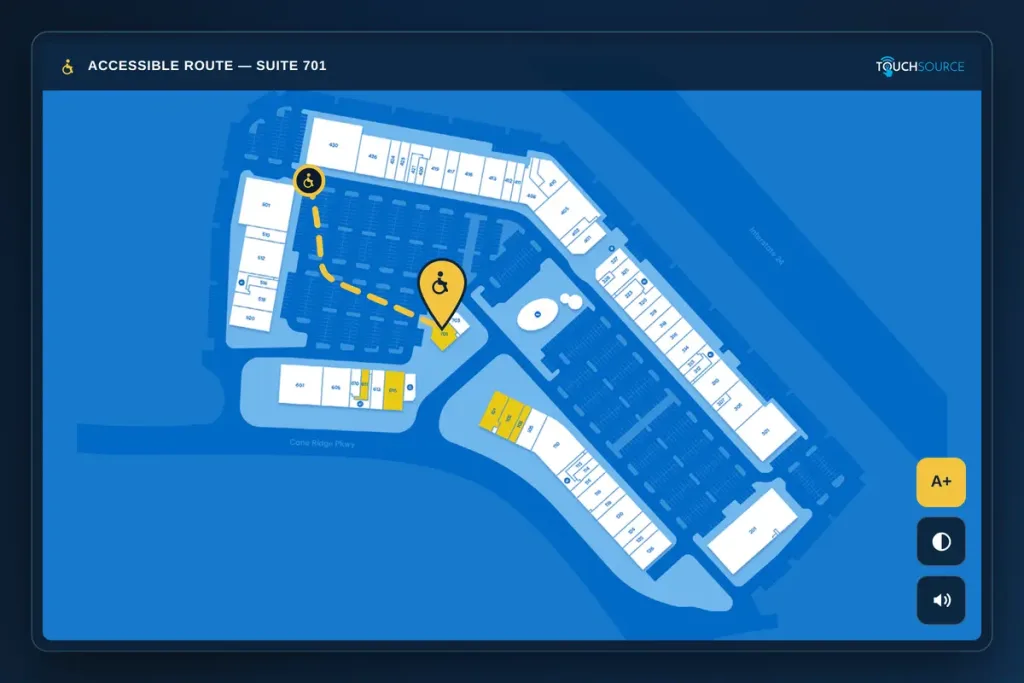
One of the things I’ve always believed is that wayfinding only works if everyone can use it.

Ajay Kapoor, CEO, TouchSource
That sounds obvious, but in practice it’s often overlooked. The industry tends to focus on maps, navigation features, design, and user experience. Those things matter. But if a visitor relies on a screen reader, keyboard navigation, or other assistive technologies and can’t effectively use the experience, we’ve created a barrier at the very moment we’re supposed to be helping them.
That’s why I’m proud to share that TouchSource has successfully passed independent accessibility testing for both our consumer-facing wayfinding experience and the SparkPX administration platform.
For our business, this isn’t about checking a compliance box.
It’s about making sure digital wayfinding works for every visitor, regardless of how they access technology.
Accessibility Is No Longer an Afterthought
Over the last few years, I’ve noticed accessibility becoming part of conversations that didn’t used to include it.
Property owners, healthcare facilities, universities, airports, and mixed-use developments are investing more in digital experiences. At the same time, expectations around accessibility have grown. People want technology that works for everyone, and rightfully so.
The reality is that accessibility isn’t just a technical consideration anymore. It’s part of the overall visitor experience.
Wayfinding has a simple job: help people get where they need to go. If someone can’t use the technology because of how they interact with it, we’ve failed at that job.
What We Learned From Real Users
That learning started well before this latest audit.
In 2024, our team spent time with the Colorado Center for the Blind to better understand how people with visual impairments navigate public spaces.
Those conversations challenged some of our assumptions. One of the biggest takeaways was that we needed to think less about flashy technology and more about practical, dependable guidance.
For someone navigating a large property independently, reliability matters. Clear, step-by-step directions that can be accessed on a mobile device or website may not be the most exciting feature to talk about, but they can make a meaningful difference in helping someone reach their destination with confidence.
Those experiences reinforced something important for our team. Accessibility can’t be something you bolt onto a product later. It has to be part of how the experience is designed from the beginning.
We shared some of those lessons in our article on blind mobility and digital wayfinding, and they’ve continued to influence how we think about product development today.
Why Accessibility Has Become a Business Conversation
What’s changed over the past few years is that accessibility is no longer being discussed only by technical teams.
Today, accessibility often comes up in conversations with facilities teams, procurement groups, operations leaders, legal departments, and executive stakeholders.
That’s because the impact extends well beyond technology.
Accessibility affects visitor experience. It affects inclusion. It affects risk. And increasingly, it affects how organizations evaluate the systems they deploy in public spaces.
When organizations are evaluating digital wayfinding solutions, I think the question is fairly straightforward:
Can every visitor independently find where they need to go? If the answer is “no,” there’s work to do.
For organizations beginning that evaluation process, our ADA and Digital Signage Compliance Guide provides additional information about accessibility considerations and best practices.
Planning a Wayfinding Project?
Download our Digital Wayfinding Accessibility Checklist to evaluate accessibility, visitor experience, and vendor requirements before deployment.
Get It HereAccessibility Has to Extend Beyond the Visitor Experience
This milestone is particularly meaningful because we’ve validated accessibility across both sides of the experience.
Visitors interact with our wayfinding tools, but property teams interact with SparkPX every day to manage content, maps, directories, and information across their properties.
True accessibility requires both experiences to work.
It’s not enough for the visitor-facing experience to be accessible if the platform used to manage that experience creates barriers of its own. We believe accessibility should apply throughout the entire ecosystem.
That’s one of the reasons this achievement matters so much to us.
Building Accessibility Into the Foundation
We’ve invested heavily in our software platform because we believe accessibility should be built into the foundation of a product rather than addressed after deployment.
Most organizations that have dealt with accessibility challenges understand why. Retrofitting accessibility later is often more complicated, more disruptive, and more expensive than designing with accessibility in mind from the start.
And this isn’t a new priority for TouchSource.
Over the years, we’ve invested in accessibility across both physical and digital experiences. That includes features that can digitally lower a touchscreen interface so someone using a wheelchair can comfortably reach and use it. It includes language tools that help make information more accessible to a broader audience. It includes product designs that avoid creating obstacles for canes, walkers, wheelchairs, and other mobility devices.
We don’t view these as separate initiatives.
They all support the same goal: helping people navigate complex places with confidence.
The Future of Wayfinding Should Be Accessible to Everyone
At TouchSource, our mission has always been to help people navigate complex places with confidence. Accessibility is a natural extension of that mission.
As digital experiences continue to evolve, organizations need solutions that not only help people get from Point A to Point B, but help everyone get there.
My hope is that accessibility becomes less of a compliance discussion and more of a design principle. When accessibility is considered from the start, everyone benefits.
This milestone is something our team is proud of, but more importantly, it’s a reflection of what we believe the future of wayfinding should look like.
Because great wayfinding isn’t just about directions.
It’s about access. For everyone.
Questions We Get About Accessibility and Digital Wayfinding
Does accessibility only matter for organizations with ADA compliance requirements?
No. Accessibility certainly supports compliance efforts, but it’s really about creating an experience that works for more people. Every day, visitors interact with technology differently based on their abilities, preferences, and circumstances. Accessibility helps ensure that everyone can independently find information and navigate a space without unnecessary barriers.
What should organizations look for when evaluating a digital wayfinding solution?
Start by asking whether every visitor can successfully use the experience. Accessibility should extend beyond the touchscreen itself to mobile directions, screen reader compatibility, keyboard navigation, and the software platform used to manage content. It’s much easier and more cost effective to address accessibility during evaluation and deployment than after a system has already been implemented.
Why is accessibility becoming a bigger consideration for property owners and facilities teams?
Organizations are paying closer attention to visitor experience, inclusion, and long-term technology investments. As digital experiences become more common throughout commercial real estate, healthcare, higher education, airports, and public spaces, there’s a growing expectation that those experiences should be usable by everyone.
Is accessibility something that can be added later?
It can be, but it’s rarely the best approach. In our experience, accessibility is most effective when it’s considered from the beginning. Designing with accessibility in mind helps reduce complexity later and creates a better experience for all users from day one.